 Swimming Lesson in KL, Malaysia
As working parents who prioritise outcomes in everything from education to extracurriculars, you’ll recognise that enrolling your child in swimming is not simply about “fun water time” — it’s about investing in a well-designed curriculum. At DSA, swimming programs for children start at a pre-learner level and follow a clearly defined progression and pathway model.
By selecting a swim school that offers a structured progression map, you ensure that your child is developing real skills, gaining confidence in the water, and reaching defined milestones. This gives you visibility of progress and return on your investment of time and money.
DSA’s Pathway and Progression
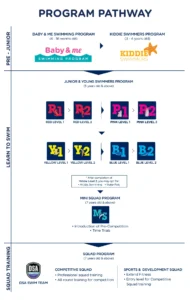
DSA divides its programs into age-based categories and within them, structured levels. Here’s what you need to know:
Age Groups & Program Categories
- For infants from 6 months up to 48 months: the “Baby & Me” program.
- For toddlers aged about 3–4 years: the “Kiddie Swimmers” program.
- For children aged 5 years and above: the “Learn to Swim” program, which is the main focus for parents looking for substantive progression. This is where the progression map becomes clearer. DSA splits this into 4 different colour-coded levels—Red, Pink, Yellow, Blue—and each level is further subdivided into two sub-levels.
- For more advanced/competitive swimmers (usually from 7 years and above): the Squad Program, etc.
What this tells you is: your child enters at an appropriate colour/level based on readiness, works through two sub-levels in that colour, then ascends to the next colour when ready. It’s a clear staircase of development.
What this structure delivers
- Clarity of stage: When your child is in, say, Yellow level (first sublevel) you know roughly where they are in the pathway.
- Readiness-based progression: Instead of age alone, the sub-level progression lets instructors assess readiness and move children forward only when they’re competent. This aligns very well with the DSA principle that students are not pressured or pushed to perform but guided to develop their skills at a rate they are comfortable with.
- Stretch and build: Children don’t stay in a beginner phase indefinitely — once they’ve mastered one colour and its two subdivisions, they step up. You’ll see progression, not stagnation.
What you (and your child) gain from this structured pathway
- Safety & confidence where it matters
The early levels (Red & Pink) focus on water‐familiarisation, safe entries, buoyancy, basic kicking and floating. The fact that DSA opens from “Baby & Me” and “Kiddie” programs into the main Learn to Swim pathway shows they place safety as a foundation. As a parent, you get assurance that your child isn’t just thrown into deep water; the program starts sensibly and builds.
- Transparent progress and outcomes
Because each level is colour coded and subdivided, you can track exactly where your child is, what they’ve achieved, and what’s next. This structure means you’re not guessing when your child will “learn to swim” — you know the stage they’re working through. - High instructional standards
DSA is noted as the largest AUSTSWIM-recognised swim centre in Malaysia which means the curriculum and instructor training meet national standards for teaching swimming and water safety. For you, this means you’re not settling — you’re engaging with a program that lives up to the kind of educational investment you make. - Pathway for future aquatic options
Once your child completes Blue level (and its two sub-levels) in the Learn to Swim pathway, they are well positioned for the Squad Programme, Artistic Swimming, Water Polo, or Diving. In other words: the investment scales beyond “basic swimming” into broader aquatic skills. That means you’re not simply paying for an activity — you’re building a skill set, opening possibilities.
Why this matters for busy professionals with high expectations
In a world where your child’s time is limited — after school, busy schedules, other commitments — every extracurricular must deliver. The difference between a casual “swim lesson” and a structured “swim education pathway” is significant. With DSA’s model you get:
- A clear roadmap with defined steps (Red → Pink → Yellow → Blue).
- A commitment to paced progression, not forced acceleration.
- Visibility and accountability: you can see where your child is, what level they’re in, and what awaits.
- Quality assurance: recognitions like AUSTSWIM, structured levels, age-based grouping, all point to serious methodology.
- Life time learning: you don’t want to just enrol your child for swimming — you want them to “learn to swim well, safely and confidently.”
Tips for maximising your child’s journey through the Pathway
- Begin with the right level — Ensure your child is placed according to capability and age. The colour-level system ensures readiness is respected.
- Stay consistent — Regular attendance helps children move through sub-levels more smoothly.
- Monitor their colour-level progression — Ask the instructor: “Which colour am they in? Which subdivision? What skills are they working on?”
- Support at home — Even a little kicking practice or water‐familiarity at home reinforces the lesson.
- Celebrate each advancement — When your child moves from Pink (sublevel 1) to Pink (sublevel 2) or into Yellow, mark it. It increases their confidence and reinforces value.
- Look ahead beyond Blue — If your child enjoys swimming, ask the instructor about what’s next: Squad, Artistic, Water-Polo. Because the foundational pathway has been delivered, those options are open.
Enrolling your child in the Learn to Swim program at DSA means you’re choosing a structured, outcome-driven progression: age-appropriate, colour-coded, readiness-based, and linked to future aquatic pathways.
For working parents who expect high-quality education and meaningful results, this is exactly the kind of program you want. You’ll know at any moment: “My child is in colour X, sub-level Y, and next we expect …”, rather than just “they go to swimming every week.” You can trust the instructors, trust the methodology, and — most importantly — watch your child become a confident, capable swimmer who enjoys the water, masters new skills, and remains safe.
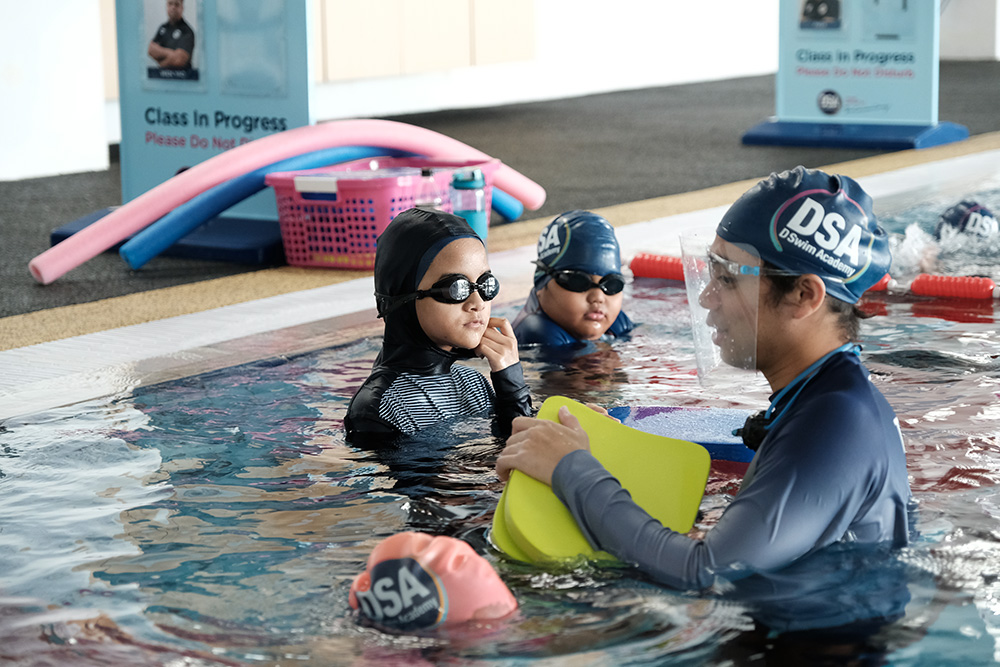
NB: Children should always be accompanied by their parents or appointed guardians when in or around the pool or any water bodies. DSA provides Learn to Swim Programs for Children for all ages. Classes are available at multiple locations across Kuala Lumpur, Selangor and Shah Alam areas in the Klang Valley, Bandar Dato’ Onn, Johor and Seberang Jaya, Penang.