 Swimming Lesson in KL, Malaysia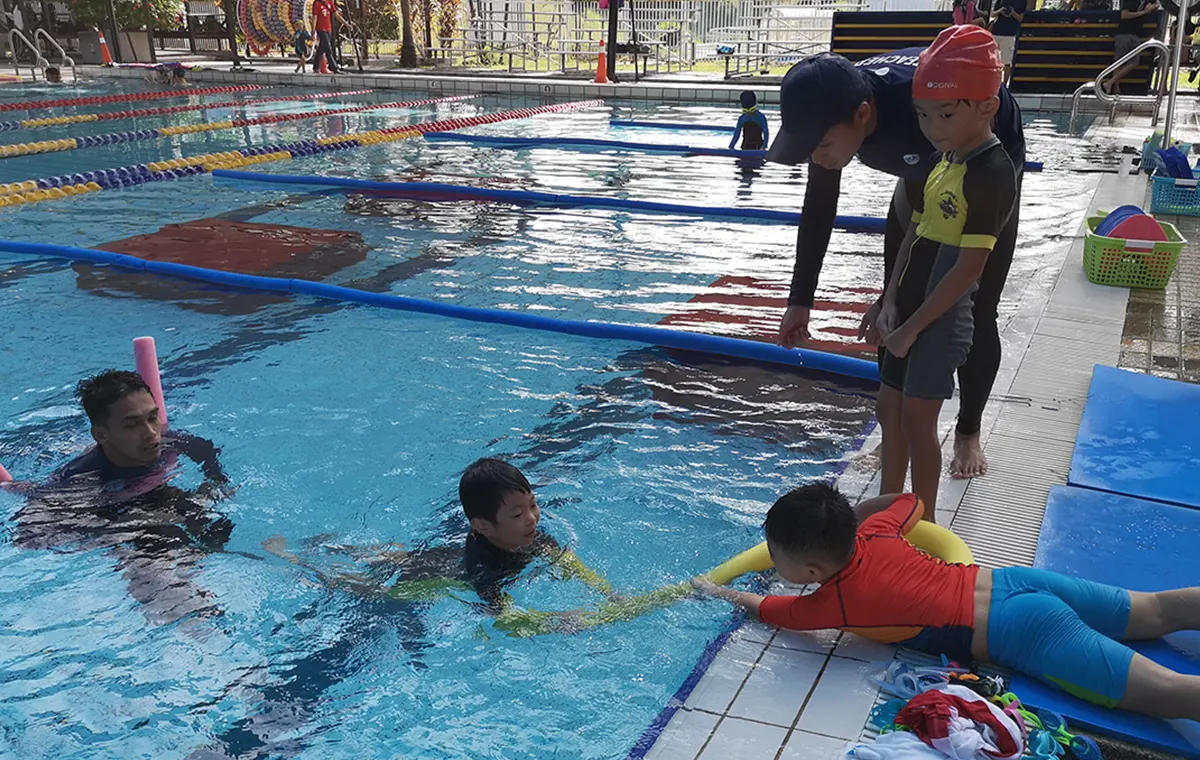
When Malaysian parents hear that a swim school follows “Australian standards,” it’s natural to picture a single, unified certificate, one seal of approval that guarantees quality. The reality is more interesting, and understanding it actually matters if you’re choosing where your child learns to swim.
Australia’s reputation as the global benchmark for swim education and drowning prevention isn’t built on one organisation. It’s a coordinated national framework, developed by a coalition of bodies that each own a different piece of the puzzle: curriculum design, teacher training, competitive pathways, and public safety messaging.
The framework behind the reputation
At the centre of the Australian system sits the National Swimming and Water Safety Framework, developed by Royal Life Saving Society Australia (RLSSA) with the Australian Water Safety Council. This is the actual curriculum — the document that sets out what Australians should be able to do in water at different ages, and the one government policymakers and swim schools are expected to align to.
Its clearest expression is a set of national age benchmarks:
- By age 6 — swim continuously for 5 metres, submerge and move through an obstacle, and know who and what to call on in an aquatic emergency
- By age 12 — tread water for 2 minutes, swim 50 metres continuously, perform a non-swimming rescue, and complete a survival sequence in clothing
- By age 17 — treading water for 5 minutes, swimming 400 metres continuously, and being able to rescue an unconscious person in deep water
Around this framework sits a coalition of at least eight partner organisations.
- AUSTSWIM trains and licenses individual swim teachers.
- Swimming Australia governs the competitive pathway from learner to elite athlete.
- ASCTA handles performance-focused coaching accreditation.
- Surf Life Saving Australia covers open-water and beach safety.
- ASSA represents swim school operators as a trade body
- YMCA and Belgravia Leisure deliver the framework at facility scale
- Public campaigns like Kids Alive Do the Five carry the water-safety message beyond the pool.
- Layered on top, Australian state education departments independently mandate water safety inside the school curriculum, meaning part of “the Australian system” is delivered through public schooling itself, not any private certifying body at all.
What has reached Malaysia
Most parents in Malaysia may not realise is that of entire architecture, it is overwhelmingly AUSTSWIM’s teacher-training layer that has travelled internationally. AUSTSWIM Southeast Asia, based in Kuala Lumpur, runs regional courses that have drawn candidates from across Malaysia, Indonesia, and Cambodia, and it’s the credential most Malaysian swim schools point to when they invoke “Australian standards.”
However the rest of the system: RLSSA’s national age-benchmark targets, the government-mandated schools curriculum, ASCTA’s competitive-coaching accreditation, and Surf Life Saving’s open-water programs has not yet been widely represented in Malaysia. That’s not a criticism of the region as Malaysia’s aquatics context is largely urban pools rather than ocean beaches, and there’s no equivalent government curriculum mandate driving the same public-health apparatus Australia has built. The transferable “how to teach” layer took root here. The full national public-health system has not yet taken root or developed in Malaysia.
Why this distinction matters when choosing a Swim School
Seen clearly, Malaysia and Singapore’s swim landscape is a mix of imported teaching standards. AUSTSWIM and the UK’s STA (delivered locally via MSTA and SSTA) compete for the same instructional role AUSTSWIM plays in Australia, while homegrown certifications like STAM’s Aquatic Educator program and Life Saving Society Malaysia’s rescue awards fill the space RLSSA and Surf Life Saving occupy in Australia, without being tied to one shared national benchmark.
That mix is exactly why the label “Australian standards” is so easy to say and so hard to verify. While a lot of swim schools can put the phrase on their marketing materials, far fewer can point to which specific part of the Australian architecture they’re actually certified in, who issued that certification, and what it obligates their instructors to do differently in the water. For a parent, that’s the real question is not “is this Australian?” but “which Australian body stands behind this, and what does that body actually require?”
It matters in practical terms, too. A teacher trained under a genuine water-safety methodology approaches a lesson differently than one trained purely for stroke technique; the emphasis on breath control, in-water rescue awareness, and structured skill sequencing shows up in how a class is actually run, not just in what’s printed on a certificate. Knowing which layer of the system a school has adopted tells you what kind of training your child is actually receiving.
How D Swim Academy applies the Australian system
At D Swim Academy, our AUSTSWIM Gold accreditation reflects exactly this, DSA’s swim teachers are trained and licensed to the internationally recognised part of the Australian framework, which is, the teaching methodology and water-safety pedagogy behind how lessons are actually delivered in the water, not a claim to Australia’s full national curriculum.
In practice, this shapes how we run lessons across every DSA branch, not just one centre or location:
- Consistent instructor standards. Every teaching instructor works to the same AUSTSWIM-licensed methodology, so a child moving between branches, or between classes as they progress, is met with the same water-safety pedagogy rather than a different informal approach from each teacher.
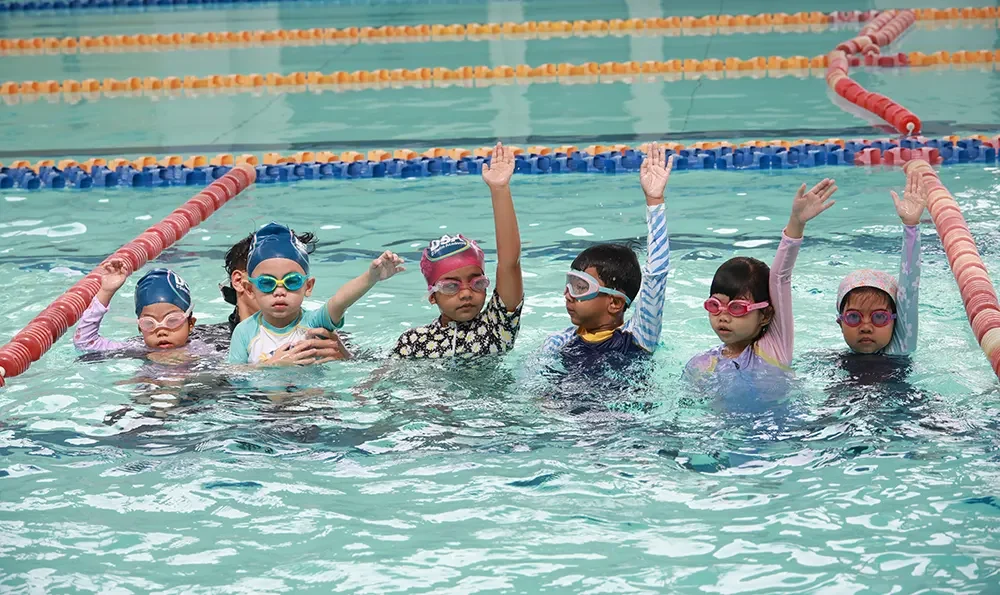
- Age-appropriate skill sequencing. Rather than treating “learning to swim” as one undifferentiated goal, we structure progression the way RLSSA’s Framework does. Building submersion comfort and basic safety awareness first, then continuous swimming distance, then endurance and rescue-adjacent skills, using RLSSA’s own age-6 and age-12 benchmarks as a useful external reference point for what “on track” looks like, even though no formal regional equivalent exists yet.
- Safety-first framing, not just stroke correction. Where a purely performance-oriented coaching approach optimises for technique and speed, an AUSTSWIM-grounded approach keeps water-safety competency; knowing what to do if something goes wrong is built into the curriculum from the earliest levels.
- Recognised externally, not just self-declared. Our AUSTSWIM Gold status and our 2025 ASSA industry recognition are both third-party markers, which matters precisely because “Australian-standard” claims are otherwise unverifiable from the outside.
None of this means DSA is delivering Australia’s entire national system — no swim school outside Australia genuinely is, and we’ve laid out exactly why in this article. What it means is that when we say “Australian standards,” we can tell you precisely which standard, issued by which body, and what it changes about how your child is taught.
NB: Children should always be accompanied by their parents or appointed guardians when in or around the pool or any water bodies. DSA provides Learn to Swim Programs for Children for all ages. Classes are available at multiple locations across Kuala Lumpur, Selangor and Shah Alam areas in the Klang Valley, Bandar Dato’ Onn, Johor and Seberang Jaya, Penang.